
 GitHub |
  GitLab mirror | Preprint
Modeling Workflow
CABS-flex standalone 3 provides three main modeling workflows: protein flexibility simulation, peptide modeling, and peptide–protein docking. Each workflow starts from different input data and is designed for a different modeling task.
In the protein flexibility workflow, the input is a protein structure. The simulation samples near-native conformational variability around the starting structure and generates representative models that can be used to analyze local and global flexibility.
In the peptide modeling workflow, the input is a peptide sequence, optionally with secondary-structure information or restraints. This workflow can be used for modeling linear peptides as well as cyclic or disulfide-constrained peptides.
In the peptide–protein docking workflow, the input is a receptor protein structure and a peptide sequence. The peptide is sampled flexibly around the receptor, either globally or with optional contact restraints guiding the search toward a selected binding region.
Despite these differences, all three workflows share a common modeling core. After input preparation, CABS-flex standalone 3 performs CABS coarse-grained simulation, followed by model selection using filtering, scoring, and clustering. Selected representative models or docking poses are then reconstructed to all-atom representation and can be further analyzed or visualized using the available output tools.
In the default mode, each workflow generates a coarse-grained trajectory containing 1000 to 10 000 models, depending on the workflow and settings. The trajectory is then filtered and clustered to select 10 representative outputs: protein conformations in the protein flexibility workflow, peptide structures in the peptide modeling workflow, or peptide–protein docking poses in the docking workflow. These representatives are reconstructed to all-atom representation, giving 10 final all-atom models or poses by default.
The number of generated models, selected representatives, sampling settings, restraint setup, reconstruction options, and analysis outputs can be modified by the user. In addition to final PDB models, CABS-flex standalone 3 provides outputs such as RMSF profiles, contact maps, scoring summaries, molecular visualization files, and generated reports.
The figure below shows the three main workflows and their shared modeling core in CABS-flex standalone 3.
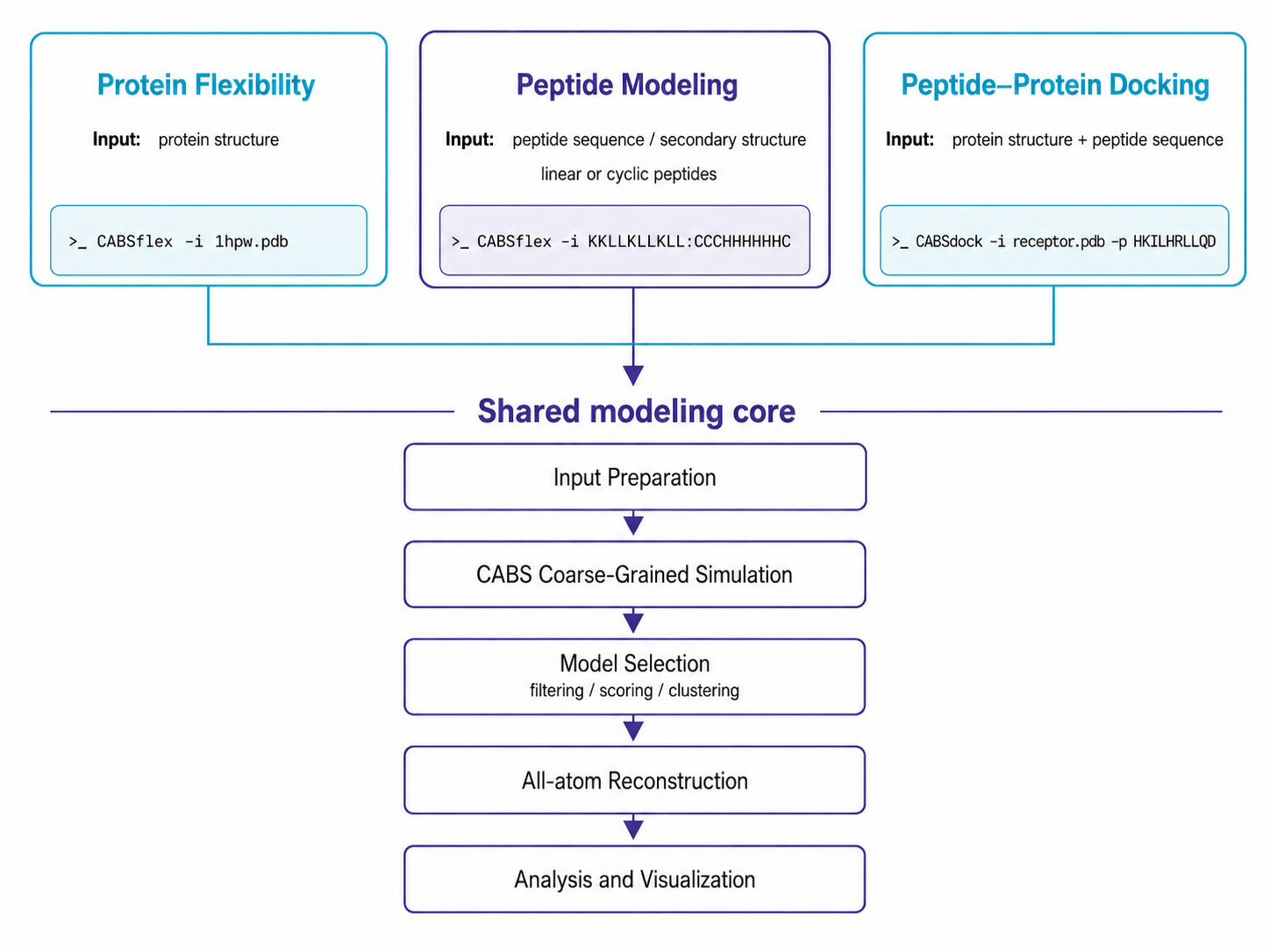
Figure. CABS-flex standalone 3 modeling workflow. Protein flexibility, peptide modeling, and peptide–protein docking workflows use different input data but converge into a shared modeling core. The core workflow includes input preparation, CABS coarse-grained simulation, model selection by filtering, scoring and clustering, all-atom reconstruction, and analysis/visualization. In the default protein flexibility workflow, 10 representative all-atom models are generated from a clustered coarse-grained trajectory.
← Installation | ⬆ Back to top | Next: CABS Model